🔴 The Most Powerful Growth Tool
For the Company and for the Manager

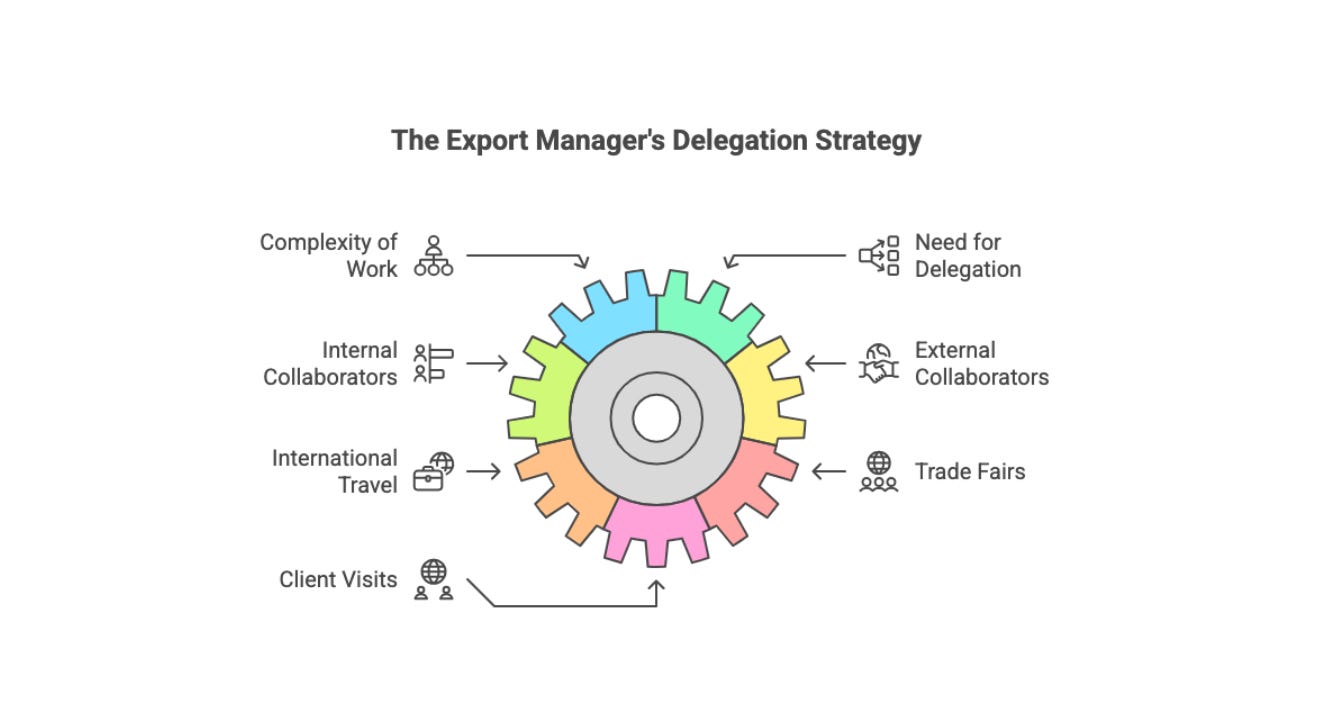
As a company grows in size, the work of the export manager becomes increasingly complex and demanding. When the export manager can no longer handle all the responsibilities alone, the time comes to share the workload by involving internal or external collaborators. This distribution of responsibilities is achieved through delegation.
The importance of delegation is common to all managers, but it is even more vital for the export manager. Those who work in export must, more often than other managers, be away from the company due to international travel, participation in trade fairs, and visits to foreign clients.
The export manager, therefore, absolutely needs to organise the export office in such a way that all export-related activities continue to function correctly and efficiently even in his or her absence.
However, it would be a mistake to view delegation solely as a means to cover for the export manager during absences. Delegation is much more than that:
It is a powerful tool for business growth, and its proper use can give a significant boost to all the activities for which the manager is responsible.
By proper use of delegation, I refer to the adoption of certain operational measures. Let’s look at them in detail:
1. Always give feedback
We must ensure we provide both positive and negative feedback, so the person being entrusted with responsibility understands whether they are performing well and how they can improve if necessary. A good performance is more likely to be sustained if it is recognised and rewarded. It is wise to be generous with promotions, bonuses, and public recognition for those who demonstrate dedication and effectiveness in carrying out the delegated task.
2. Ensure a good level of control is maintained
This is a somewhat controversial point. Many management consultants suggest delegating certain responsibilities without imposing any control over the delegate’s actions, focusing solely on evaluating the results.
Personally, I disagree with this type of complete detachment from the delegate’s activities. Limiting control to the results achieved may highlight problems and critical issues when it is too late to address them effectively and economically. I believe that monitoring the work of collaborators will motivate them more and help the manager solve problems as they arise.
An inexperienced team member will need closer supervision, whereas more experienced collaborators can enjoy greater autonomy and manage their decisions independently to achieve the agreed results.
The degree of control over the delegate should be proportional to their level of skill and experience.
3. Be clear and detailed about the tasks being delegated and the expected results
Ensure that collaborators understand the responsibilities they are taking on and that they accept them. It is advisable to ask them to confirm that all aspects of the delegation have been understood, both in operational terms and in their implications.
4. Choose carefully which tasks to delegate
It is wise to delegate repetitive tasks and low-complexity activities that require a significant amount of time to complete. Never delegate:
the evaluation of other collaborators’ performance
the authority to override standard procedures with exceptional measures
actions based on ethical judgements about the company’s operations
tasks specifically assigned to us
particularly complex situations
sensitive matters that could compromise commercial relationships with clients.
5. Provide all necessary guidance and clarification
When, without valid reason, an activity strays from the usual guidelines, the export manager must indicate immediate and decisive corrective action by preparing a plan to realign with the intended objectives.
6. Give collaborators the necessary authority to complete the delegated task
Any delegated task must be accompanied by an appropriate delegation of authority, power, and resources to complete the assignment successfully.
The manager must always ensure that a proper balance is maintained between the collaborator’s power and responsibility.
This applies to any worker within any company: one is (and feels) truly responsible only when empowered to make the changes deemed necessary to achieve their goals. The general principle to follow is:
Everyone is responsible for what they do, what they have others do, what they control, and what they have the power to change.
7. Maintain the right attitude towards delegation
Managers, especially the most creative and proactive, often see the need to organise delegation as a nuisance or an obstacle to their work. On the contrary, assigning delegations should be regarded as an investment in people, corporate culture, and the operational outcomes of the entire export office. It is a profitable operation aimed at the strategic growth of the company and must be treated with the attention it deserves.
8. Consider the capabilities, experience, and interests of collaborators
When assigning a task, it is necessary to consider each collaborator’s abilities, interest in the activity, and current workload. We should review the results they have achieved in similar roles, evaluate their ability to collaborate within the team involved in the same project, and carefully assess their capacity to work under tight deadlines and pressure.
9. Set clear objectives and precise evaluation criteria
It is necessary to explain in detail both the general objectives of the delegated activity and the criteria that will be used to measure its results.
Ensure that objectives are specific, achievable, relevant, and measurable.