🔴 How to Avoid Scams and Non-Payment in International Trade
Warning Signs and Protective Strategies

When people talk about international trade, they often think of the great opportunities for commercial success. And for good reason.
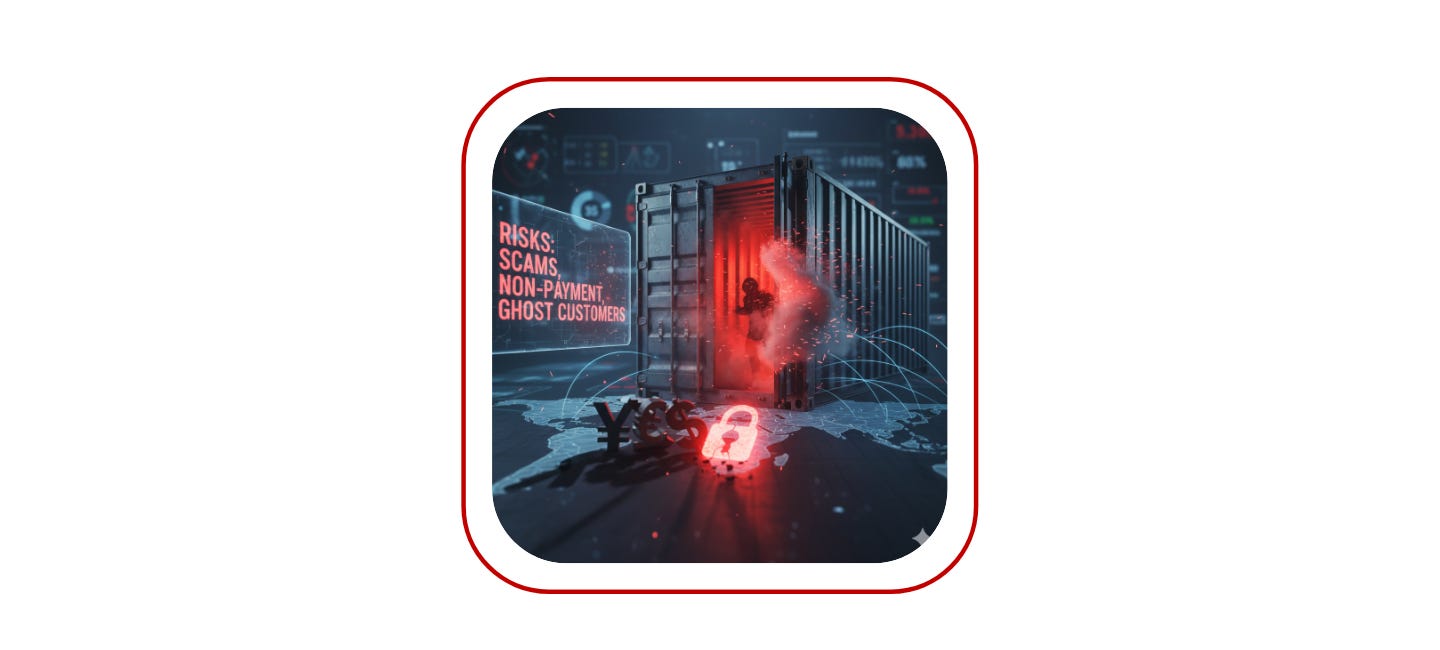
But alongside the opportunities, the world of exporting also carries risks. One of the most insidious of these relates to international payments: scams, non-payment, and customers who vanish into thin air after receiving the goods.
Today, I want to give you a practical guide to recognising the warning signs and, most importantly, how to take concrete steps to protect yourself.
1. The Red Flags to Spot Immediately
There are several red flags that, if spotted in time, can save you from very unpleasant situations. Here are the most common ones:
Requesting overly favourable terms: The customer asks for unusually long deferred payment terms or excessive discounts that are not justified by market conditions.
Vague or generic communication: Your contact avoids providing clear references, complete registered company details, or verifiable physical addresses.
Unwarranted urgency: They want to close the deal quickly, without asking many questions, perhaps even bypassing normal checks or internal procedures.
Anomalies in documentation: Letters, order confirmations, or contracts contain significant grammatical errors, suspicious addresses, or inconsistent bank details.
High-risk countries: Certain destinations (or specific regions within countries) are statistically more exposed to fraud and non-payment.
If you encounter one or more of these signs, do not ignore them. Pause and investigate further immediately.
2. How to Protect Yourself Effectively
Now let’s move on to the most important part: what to do to protect yourself.
a) Vet Your Customer
First and foremost, conduct thorough commercial due diligence. Use official sources (such as Chambers of Commerce or company registers) or engage a specialised credit-checking agency. If possible, ask for bank or trade references. And don’t rely on first impressions: appearances can often be deceptive.
b) Use Secure Payment Instruments
If the risk is high or you do not yet know the customer well, favour guaranteed payment instruments:
Letter of Credit (L/C): If properly issued and checked, this offers almost comprehensive cover.
Advance Payment: For small amounts or first-time orders, this is an excellent form of protection that buyers are often willing to accept.
Credit Insurance: If you handle significant volumes, consider taking out an insurance policy against the risk of non-payment.
You should absolutely avoid shipping goods on long payment terms without any safeguards, especially with a new customer.
c) Pay Attention to Logistics
The way you ship the goods can also make a difference. For example, if you use a negotiable Bill of Lading, you can retain control over the goods until an agreed payment or release is made (such as in a Documentary Collection - CAD/Cash Against Documents). Avoid shipping on “open account” terms or without adequate documentation when you have doubts about the other party’s solvency and integrity.
d) Include Clear Clauses in Your Contract
A simple “order by email” is not enough. Draw up a formal international sales contract that specifies:
Payment terms (timing, method, currency).
Incoterms (contractual clauses defining the division of costs and responsibilities during transport).
Jurisdiction or an arbitration clause in case of disputes.
Retention of Title (RoT) clauses, where applicable.
A clear contract does not eliminate risk, but it does provide you with stronger legal protection.
3. When in Doubt... Trust Your Judgement
Finally, there is a golden rule: if something doesn’t feel right, it probably isn’t. Don’t force a deal just for the sake of making a sale at all costs. It’s better to lose an order today than to lose money (and potentially your reputation) tomorrow.
Exporting can be an extraordinarily profitable activity, but it requires a methodical and prudent approach. Preventing the risk of scams and non-payment is an essential part of a strategy for sound international commercial growth.
Put these rules into practice, and you will have already done half the work. The other half, as always, comes down to experience, attention to detail, technical knowledge, and a great deal of common sense.
Happy exporting!
See you in the next one!
Roberto