🔴 Calculating Chargeable Weight
A Key Concept for Export

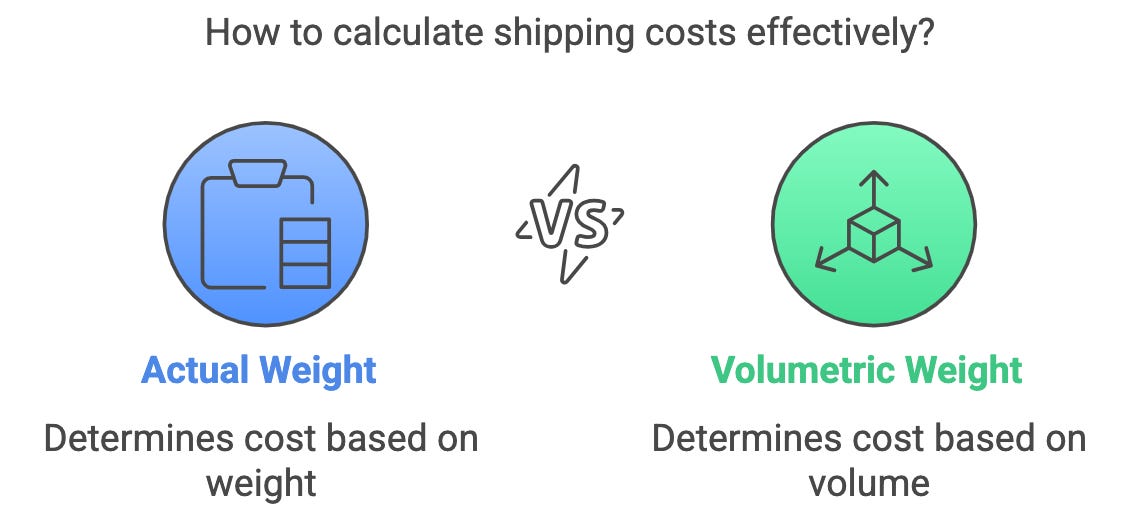
When it comes to international shipping, understanding the concept of chargeable weight is essential for exporters. This term is used to determine the cost of transporting goods and may vary depending on the mode of transport: sea, air, or road. Let’s explore what chargeable weight means and how it is calculated across different shipping methods, with practical examples and tips for optimising packaging and reducing costs.
As you might imagine, carriers aim to maximise profits by charging for the transportation, and they must take into account both the actual weight and the volume of the goods.
Chargeable weight—technically known as volumetric weight—is a method used by carriers to calculate the cost of transportation. Instead of relying solely on the actual weight of packages, chargeable weight also considers their dimensions, i.e., the total volume.
This is because every mode of transport has both a capacity limit and a weight limit.
In general, to calculate chargeable weight, the total volume of the packages (length × width × height × number of packages) is multiplied by a specific factor, which varies depending on the mode of transport. This factor is referred to as the conversion factor or taxable density.
Another common rule is that carriers will charge based on either the actual weight or the volumetric weight—whichever is greater.
Sea Freight
For sea shipments, the standard conversion factor is 1 m³ = 1000 kg, meaning a weight/volume ratio of 1:1.
In practice, this means that the sea carrier will charge the same amount for a load of one cubic metre as for one tonne of weight.
So, if a package measures 100 x 100 x 100 cm = 1 m³, its chargeable weight will be 1000 kg, even if its actual weight is lower. But if the same 1 m³ package weighs more than one tonne, the carrier will charge based on the actual weight instead of the volume.
Example:
A package measuring 150 x 150 x 150 cm (3.375 m³) weighs 200 kg.
The chargeable weight is: 3.375 × 1000 = 3375 kg.
In this case, the carrier will charge for a weight more than 15 times higher than the actual weight of the cargo.
Air Freight
For air shipments, the conversion factor is 1 m³ = 167 kg, giving a ratio of 1:6.
Therefore, a 1 m³ package has a chargeable weight of 167 kg (rounded, as the exact figure is 166.666...).
Example:
A package measuring 140 x 140 x 140 cm (2.744 m³) weighs 100 kg.
Using the conversion factor of 167 kg/m³, the chargeable weight becomes: 2.744 × 167 = 459 kg (rounded up).
The air carrier will therefore charge for a weight of 459 kg instead of the actual 100 kg.
Road Freight
For road shipments, the standard conversion factor is 1 m³ = 333 kg, equivalent to a 1:3 ratio.
Thus, a 1 m³ package has a chargeable weight of 333 kg.
Example:
A package measuring 160 x 140 x 70 cm (1.568 m³) weighs 200 kg.
The chargeable weight is: 1.568 × 333 = 523 kg (rounded).
In this case, the road carrier will charge for more than double the actual weight.
How to Optimise Packaging and Reduce Chargeable Weight
Reduce packaging volume: Use compact packaging suited to the size of the goods. Avoid excessive empty space that increases volume.
Use lightweight materials: Opt for lightweight packaging materials that still provide protection. Materials such as polystyrene or lightweight foams can be very effective.
Consolidate shipments: Combine multiple items into a single shipment to reduce overall volumetric weight compared to sending items individually.
Plan packaging carefully: Design packaging to maximise the use of internal space and minimise external volume. Modular boxes can help optimise space efficiency.
Work with a logistics expert: A skilled consultant can offer tailored solutions to optimise shipping costs, taking your company’s specific needs into account.
Understanding the concept of chargeable weight and knowing how to calculate it correctly is crucial for optimising shipping costs and improving logistics efficiency. By applying smart packaging strategies and consolidating shipments, companies can significantly reduce chargeable weight and associated costs.
Investing in well-managed logistics not only improves profit margins but also enhances competitiveness in the international market.